Joints
Joints
Dovetail 
The dovetail joint is commonly used to join the sides of wooden drawers to the drawer front and back pieces. It provides incredible strength for withstanding the pressure exerted by heavy objects placed inside drawers. Dovetails are also frequently used to attach aprons, rails, and stiles to the legs of chairs, tables, and cabinets.
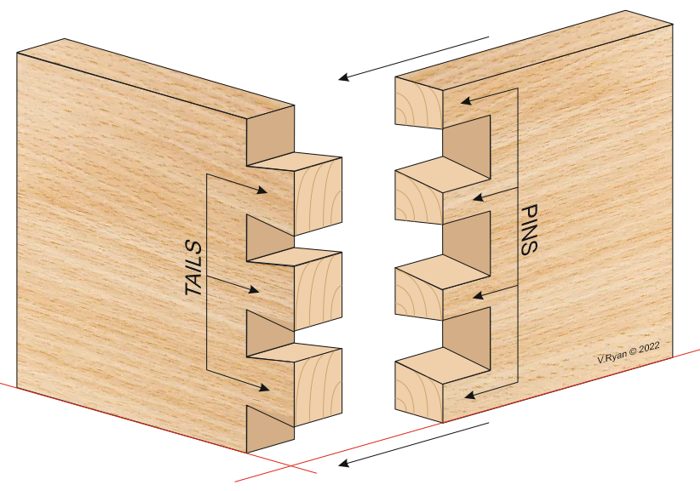
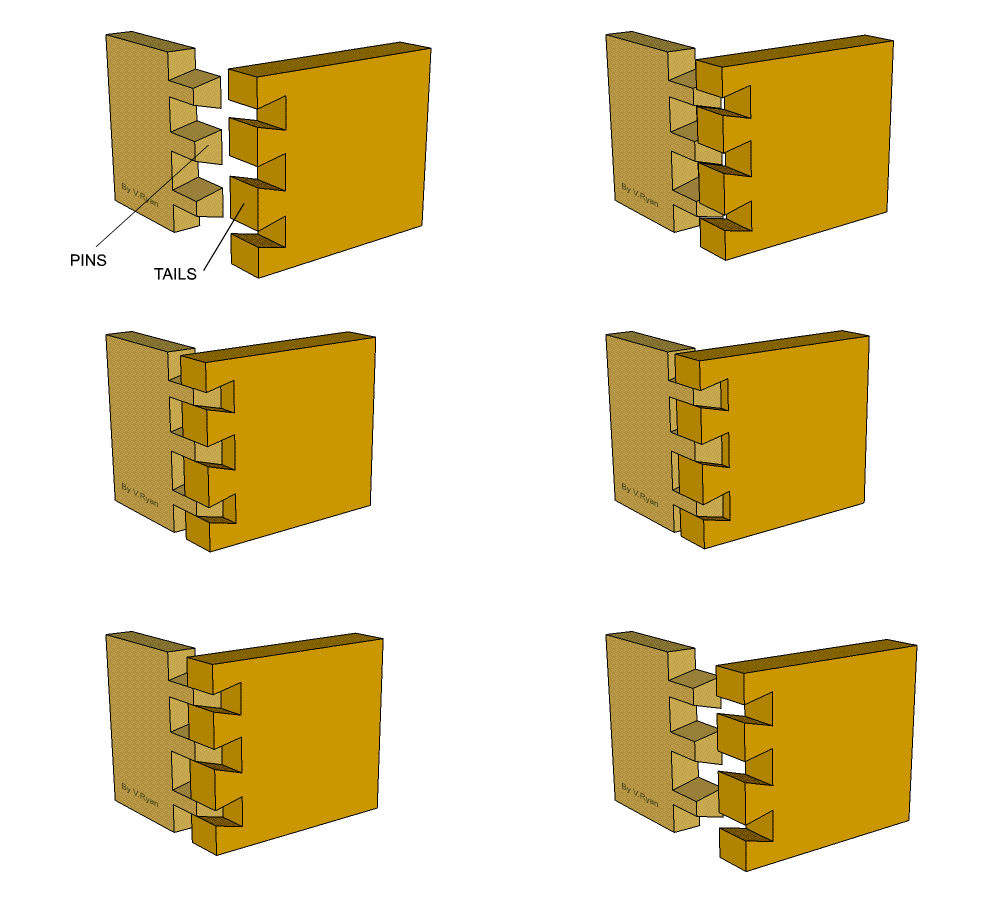
A key feature of the dovetail joint is that the grain of the wood must run parallel to the length of each piece being joined. This is important because the joint relies on wood's natural strength across the grain for its holding power. One end of one board is cut with a series of triangular "tails" that resemble the shape of a dove's tail feathers. Meanwhile, the matching end of the other board is cut with an equal number of corresponding "pins" that are angled to receive the tails.
By angling both the tails and pins, the joint prevents the pieces from being pulled directly apart in a straight line. Instead, the dovetail shape locks the two pieces firmly together. It also allows for wood movement as humidity levels change, which can cause wood to expand and contract slightly. The joint derives its tremendous durability from the large bonding surface area created by the interlocking tails and pins. Fasteners are generally not required.
Properly cutting dovetails requires sharp chisels and careful hands, as the joints must fit precisely. The process is usually done entirely by hand for the highest quality. When cut well, dovetails conceal the connection between pieces while revealing the craftsmanship that went into their formation. They create a strong, robust corner joint that withstands heavy stress and strain over many years of use.